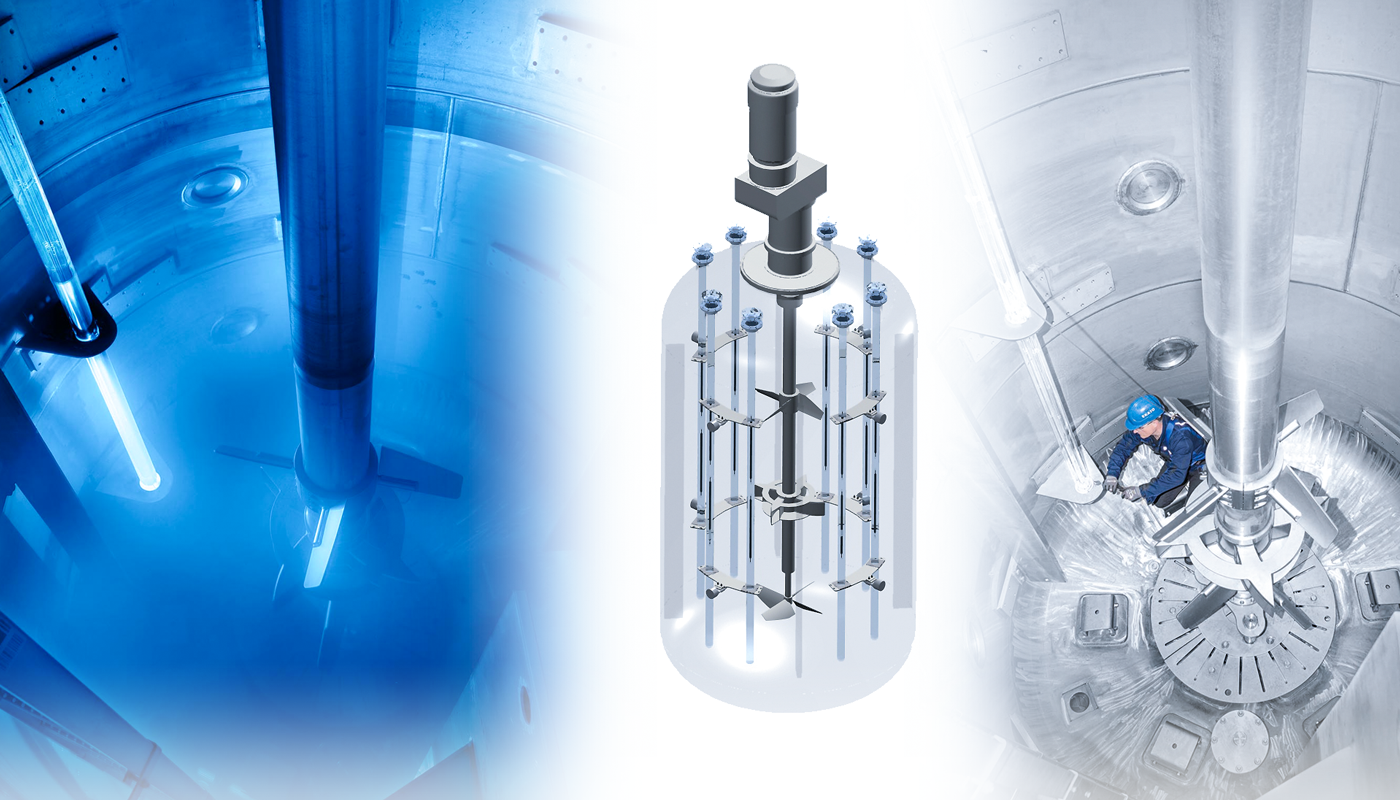
New Syntheses by Stirred Photoreactors - Turnkey from One Source
Chemical reactions can be triggered by UV light without any catalysts. The EKATO stirred photoreactor is ideal for multiphase reactions with liquids, gases and solids.
Contact us today to connect directly with our Sales Project Manager and discover how we can enhance your process, equipment, and overall plant efficiency.
A large number of chemical reactions are carried out at temperatures between 100 and 250 °C in order to achieve a fast reaction and thus high productivity. At these temperatures, however, decomposition processes already start with corresponding losses in yield and undesired by-products.
With the help of catalysts, reactions can be activated even at lower temperatures, but are expensive to procure and to handle. Photochemistry offers an elegant alternative and allows new syntheses. Not heat or catalysts, but the energy of light activates the reaction, which can then take place at temperatures well below 100 °C and often even at room temperature. By this process, decomposition or by-products are reduced to a minimum or do not arise at all. Light instead of heat, this principle can be applied to a variety of syntheses such as chlorinations, sulfonations, sulfoxidations or nitrosylations.
Process
Product
Industry
Multiphase
Chlorination
Intermediates, Solvents, C-PVC, Rubbers
Specialties, Polymers
l-g, l-g-s
Bromination
Intermediates
Specialties
l
Sulfoxidation
Intermediates, Sulfonic acids, Surface active materials
Specialties, Consumer products, Polymers
l-g
Sulfochlorination
Intermediates, Sulfonic acids, Surface active materials
Specialties, Consumer products, Polymers
l-g
Nitrosylation
Intermediates, Nylon 6 and 12
Specialties, Polymers
l-g-s
Oxidation
Intermediates, Surface active materials
Specialties, Perfumes, Pharmaceuticals
l, l-g, l-g-s
Isomerization
Intermediates
Specialties, Pharmaceuticals
l
Cycloaddition, electrocyclic reactions
Intermediates
Specialties, Pharmaceuticals
l
Polymerization
Polymers
Specialties, Polymers
l, l-g, l-g-s
The Turnkey EKATO-Photoreactor
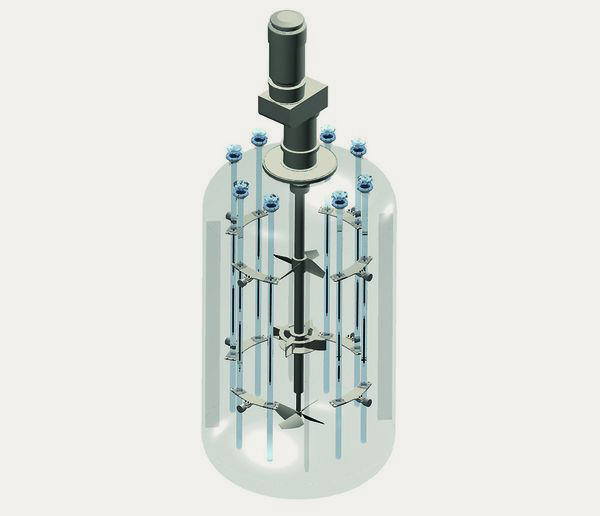
The stirred photoreactor from EKATO allows syntheses by the energy of light and an advanced stirring technique which ensures high circulation rates in the reactor. The concept of this new stirred reactor is ideal for multiphase reactions involving liquids, gases and solids. It combines high productivity and flexibility with the safe operation of immersed light sources. Reactors up to 50 m³ are realized with this proven design and a safe scale-up by our specialists enables further reactor sizes.
Stirred photoreactor
The UV Light Sources - Safe Operation
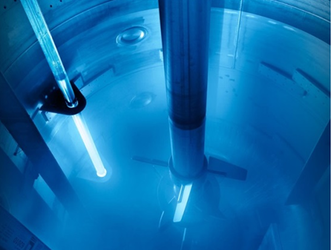
The light sources are ATEX-certified mercury vapor or LED lamp modules, which we obtain via our cooperation partner, Peschl Ultraviolet GmbH (the global expert in the field of industrial UV light sources).The UV light modules are housed in protection tubes made of quartz glass, which are inserted through nozzles in the top of the vessel, where they are also connected to the power supply and the cooling system. These UV immersion lamps have a power of 5 - 60 kW. Therefore, a cooling within the glass tube is required, otherwise the sensitive molecules can be damaged by high surface temperatures. Industrial reactors are equipped with 4 to 20 of such glass tubes.The glass tubes with their light sources are exposed to hydraulic and thermal loads in the stirred vessel. A particular challenge in this case is secure mounting of the UV immersion lamps on the reactor.Special holders developed and patented by EKATO to ensure that in any operating condition impermissible stresses or vibrations will not occur in the component. Dangerous reactants are detected immediately even in the unlikely event of a glass breakage and do not reach the outside via the electrical connections or the cooling. In EKATO’s technical center the reliability of these designs was investigated by tests and it has been comprehensively confirmed in numerous operational assignments.
The Agitator System - High Circulation Rates Required
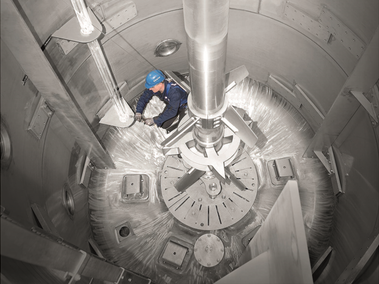
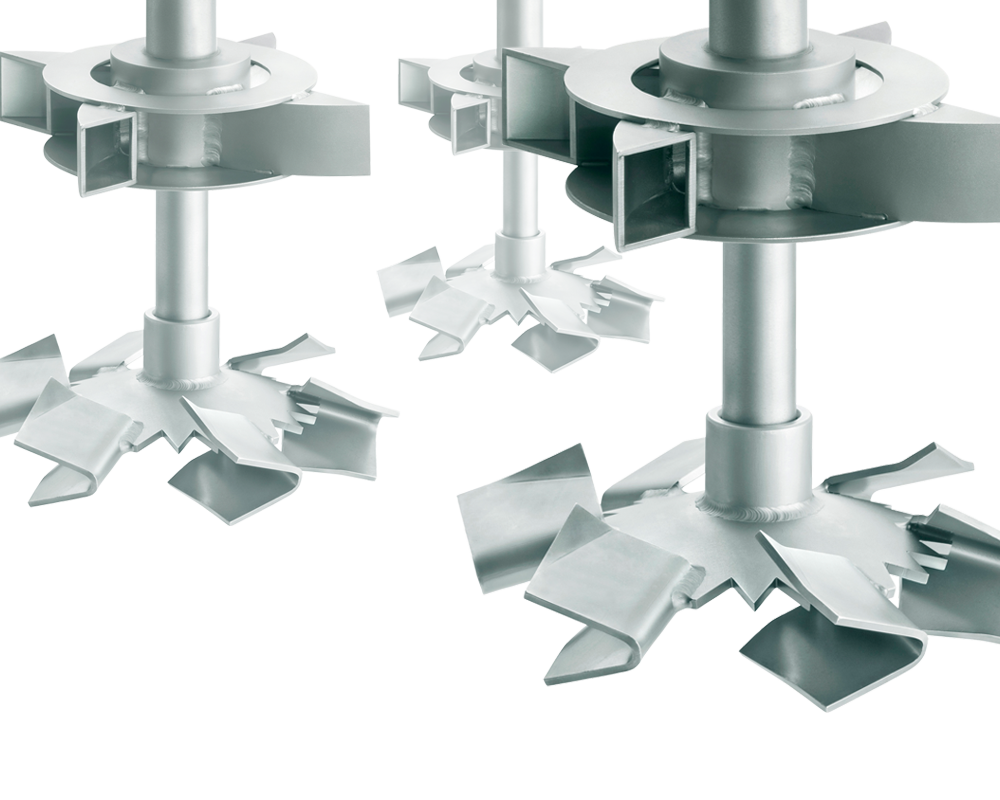
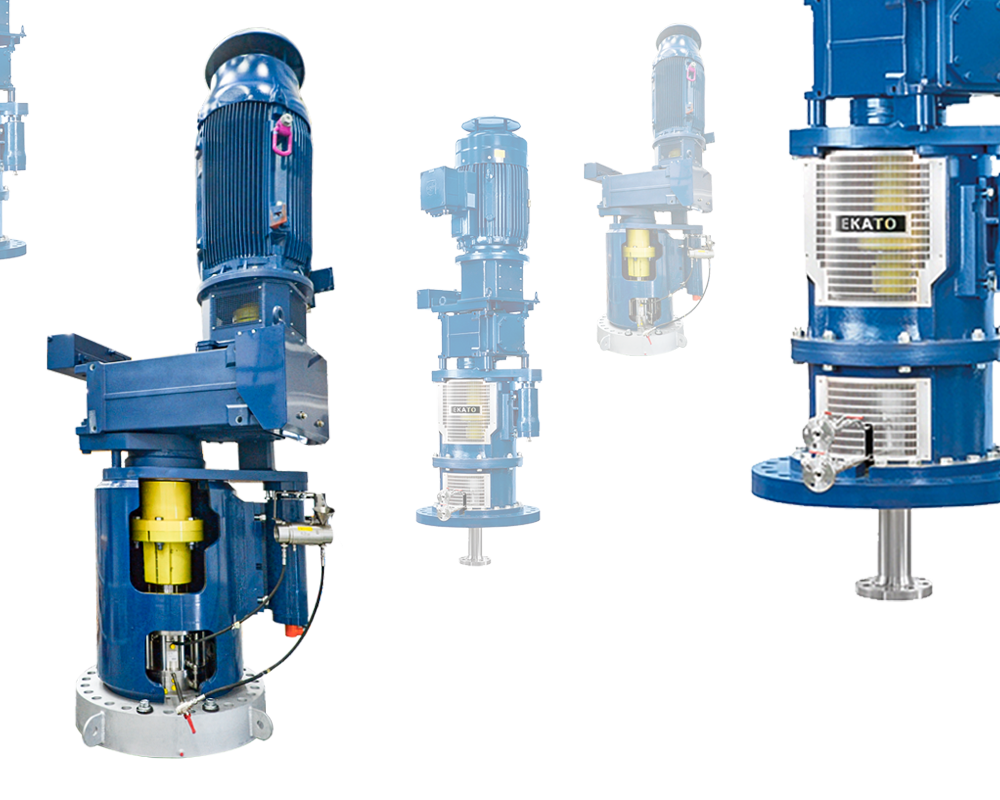
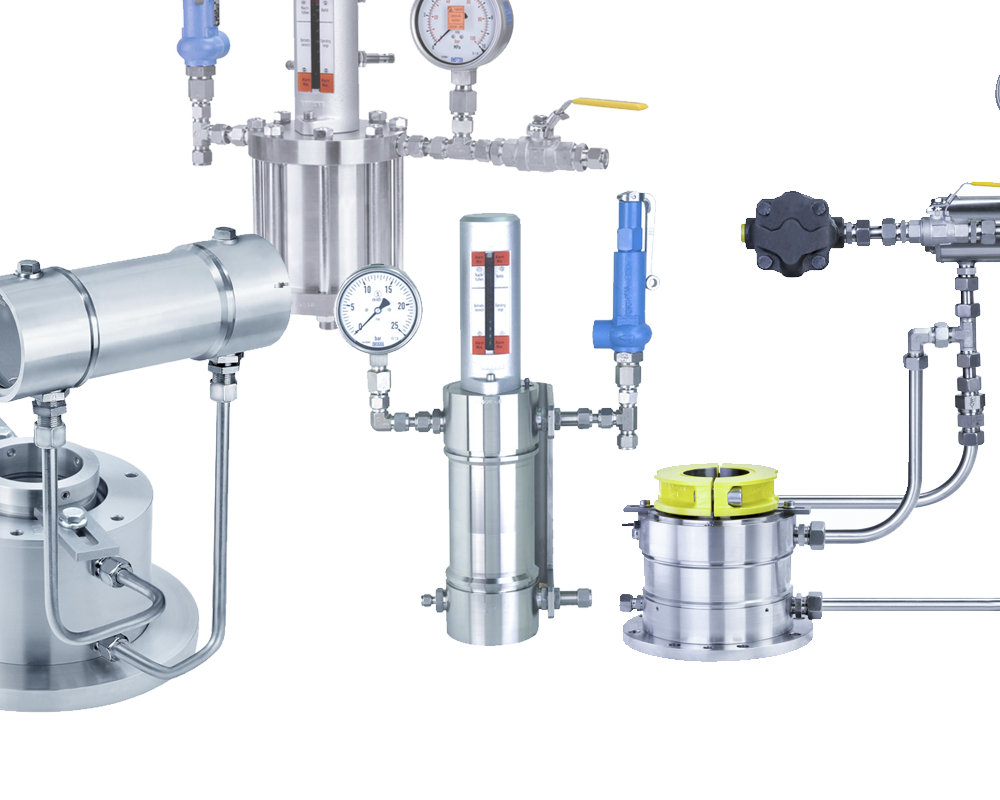
The UV radiation penetrates only slightly into the product. The mixing system is individually tailored to the reactions and ensures through the high circulation rates that the reactants are optimally transported to the light sources.The EKATO Combined Gassing System with its self-priming turbine is used for gassed application such as chlorination processes. Gaseous reactants such as Cl2, O2 or SO2 are efficiently dispersed to achieve maximum mass transfer for high space-time yields.The homogeneous distribution of solids (e.g. Polymers) and the dissipation of the heat of reaction are also an important challenge when designing the vessel and agitator. This is optimally solved by the EKATO photoreactor.When using hazardous substances, e.g. Chlorine gas, questions about the sealing and safety concept are at the top of the list of priorities. It is important to keep an eye on the big picture.The sealing of the agitator shaft to the atmosphere is a key element for operational safety. EKATO uses special double-acting or triple-acting mechanical seals or even magnetic drives from our own production.EKATO photoreactors can be manufactured from numerous material variants. Common materials are: enameled steel, stainless steels, Ni-base materials or titanium.
Overall Responibility as your Single-Source Supplier
From consulting and engineering to production and assembly: We offer all services related to stirred photochemical reactors for industrial applications. As a single-source supplier, EKATO takes the overall responsibility to manage your project through all project phases. Special know-how and many years of experience in the design and delivery of stirred reactors make us a competent partner – from the idea to the commissioning of a photochemical production plant.
Scale-up
From the Laboratory to the Turnkey Production
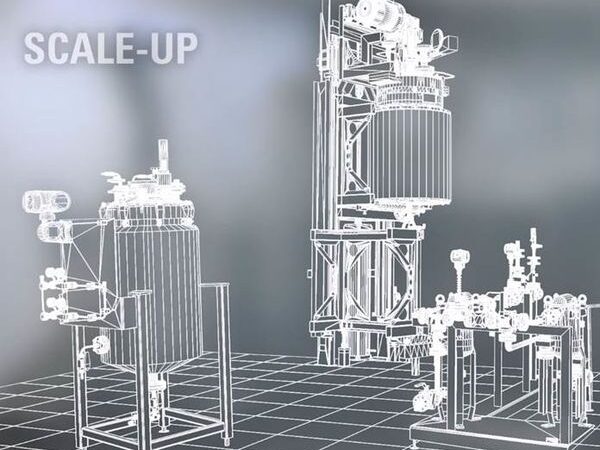
The transfer of photochemical processes from laboratory to production requires in-depth, interdisciplinary knowledge and experience in chemistry, physics and engineering. EKATO bundles the knowledge, which is very widely distributed in the individual fields of expertise, and offers comprehensive and competent consulting in the field of stirred photochemical reactors.
Our Range of Services Includes
Photochemical process consulting
Physical and fluid dynamics simulation and calculation
Performing optical measurements
Tests in laboratory scale and pilot reactors (5 liter and 50 Liter)
Scale-up and process engineering reactor design
Reactor modeling by state-of-the-art CAE methods (CFD, FEM)
Reactor engineering
Delivery of the turnkey photochemical reactor
Installation and commissioning
Our Customer Promise
Our aim is to consistently support our customers as a development partner and system integrator on the way from the idea to the photochemical production plant. As a single-source supplier, we assume overall responsibility for the design and delivery of the best reactor system for each individual customer process. Everything works together perfectly to reduce friction losses and costs. We reduce the interfaces of our customers when planning a photochemical production plant to one point of contact.

Process Plants and Units contact form
Related Topics
You may also be interested in these topics
Combined Gassing
An agitator system of EKATO PHASEJET and GASJET combining high gas rate dispersion with the internal gas recirculation.
Top-entry and side-entry agitators (e.g., EM 2000, ES 2000, MD/SD)
Solutions for storage tanks, open and closed vessels
Simple mechanical seals
Short delivery times, high cost-efficiency
On-site commissioning and service
What does “Number of sealing faces” mean?
Single-acting mechanical seals These seals have one sealing surface and only seal in one direction. They are generally simpler in design and are commonly used in applications where pressure is applied from only one side.
Double-acting mechanical seals These seals have two sealing surfaces and can seal in both directions. They are ideal for applications where pressure may come from both sides or where a higher sealing performance is required.
Triple-acting mechanical seals These are less common and used in specialized applications that require a more complex sealing setup. They offer additional sealing surfaces or mechanisms to ensure reliable sealing even in highly demanding environments.
You are currently viewing a placeholder content from Google Maps. To access the actual content, click the button below. Please note that doing so will share data with third-party providers.
You are currently viewing a placeholder content from Facebook. To access the actual content, click the button below. Please note that doing so will share data with third-party providers.
You are currently viewing a placeholder content from hCaptcha. To access the actual content, click the button below. Please note that doing so will share data with third-party providers.
You are currently viewing a placeholder content from Turnstile. To access the actual content, click the button below. Please note that doing so will share data with third-party providers.