
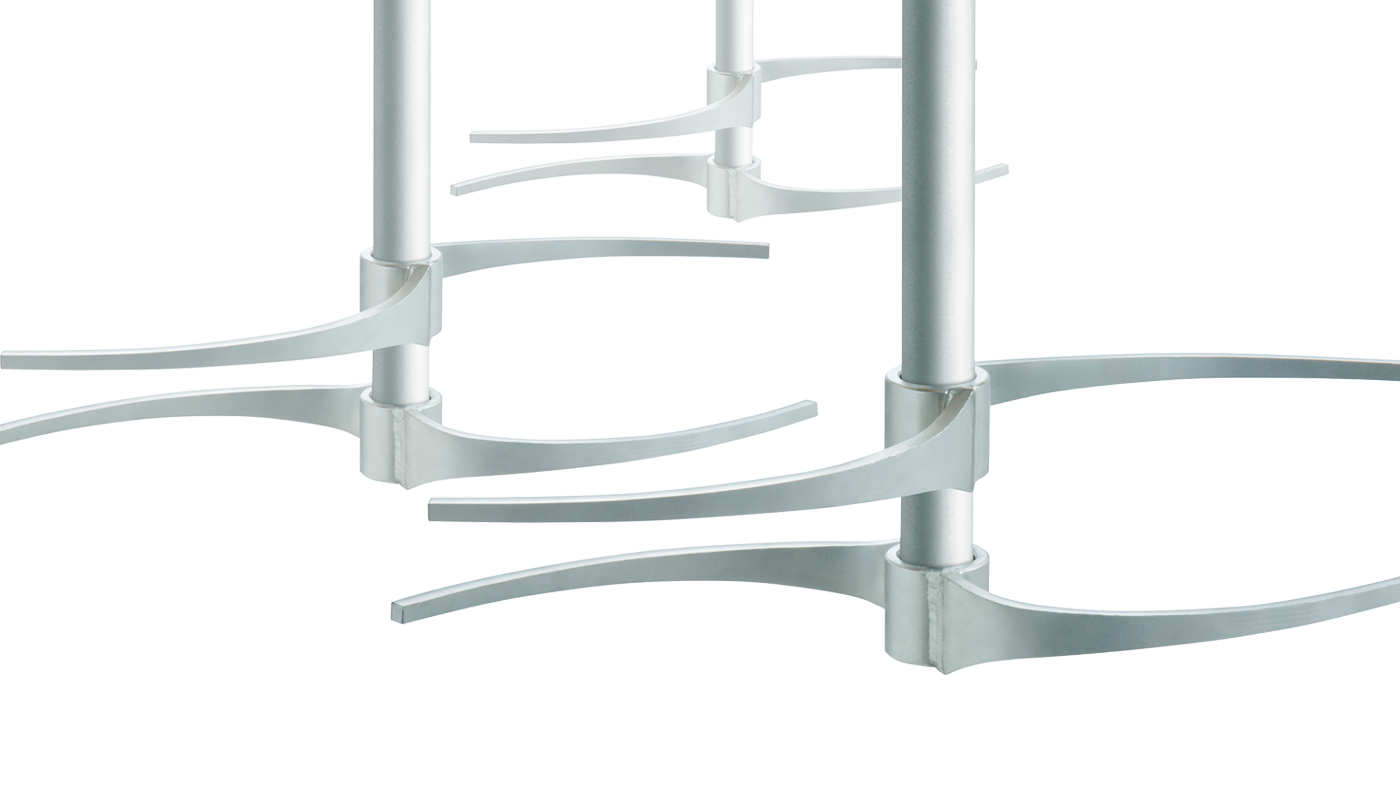
An impeller for continuous mixing or handling of bulk materials which avoids clumping of adhesive bulk materials and intensifies the surface contact between solid and fed gas through surface renewal.
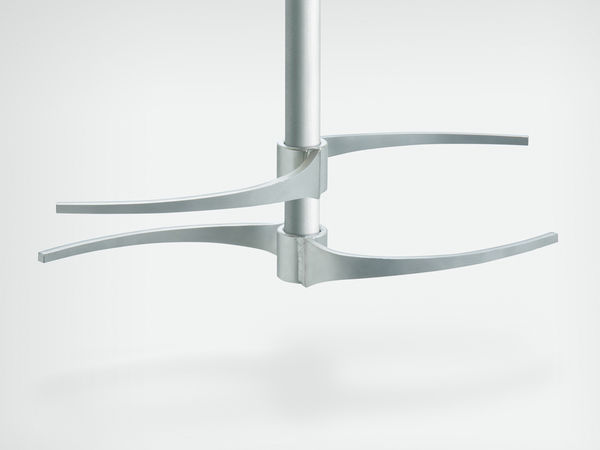
Agitators are normally used during continuous mixing or handling of bulk materials. One the one hand, this is important to allow a mixing process. On the other hand, mixing avoids clumping of adhesive bulk materials or intensifies the surface contact between solid and fed gas (surface renewal) , for example, when stripping monomer residues from polymers. To serve this application, EKATO developed the EKATO SOLIDFOIL as a result of extensive trials in our own laboratory. This impeller is normally applied as a multi-stage mixing system. The unique blade profile diverts the solids axial flow through the vessel into a radial alternate outward and inward direction. As a result, a narrow residence time distribution in the entire vessel occurs, leading to an uniform process result and a better product quality. Simultaneously, the bulk material is permanently restructured which avoids clumping, continuously offering new surfaces for desorption processes for example..
EKATO SOLIDFOIL
Features
Uniform process results due to narrow residence time distribution in equipment with vertical flow
Optimized blade profile that conveys the solids alternately outwards and inwards in a radial direction
The curvature and adapted height of the blade generates a constant volumetric flow rate along the blade
The blade geometry can be adapted to the wall friction angle of the product

Impeller Contact Form
Related Topics
You may also be interested in these topics
Plastics
When producing polymers, it is the right mixing solution that decides about the final product quality.
Top-entry and side-entry agitators (e.g., EM 2000, ES 2000, MD/SD)
Solutions for storage tanks, open and closed vessels
Simple mechanical seals
Short delivery times, high cost-efficiency
On-site commissioning and service
What does “Number of sealing faces” mean?
Single-acting mechanical seals These seals have one sealing surface and only seal in one direction. They are generally simpler in design and are commonly used in applications where pressure is applied from only one side.
Double-acting mechanical seals These seals have two sealing surfaces and can seal in both directions. They are ideal for applications where pressure may come from both sides or where a higher sealing performance is required.
Triple-acting mechanical seals These are less common and used in specialized applications that require a more complex sealing setup. They offer additional sealing surfaces or mechanisms to ensure reliable sealing even in highly demanding environments.
You are currently viewing a placeholder content from Google Maps. To access the actual content, click the button below. Please note that doing so will share data with third-party providers.
You are currently viewing a placeholder content from Facebook. To access the actual content, click the button below. Please note that doing so will share data with third-party providers.
You are currently viewing a placeholder content from hCaptcha. To access the actual content, click the button below. Please note that doing so will share data with third-party providers.
You are currently viewing a placeholder content from Turnstile. To access the actual content, click the button below. Please note that doing so will share data with third-party providers.