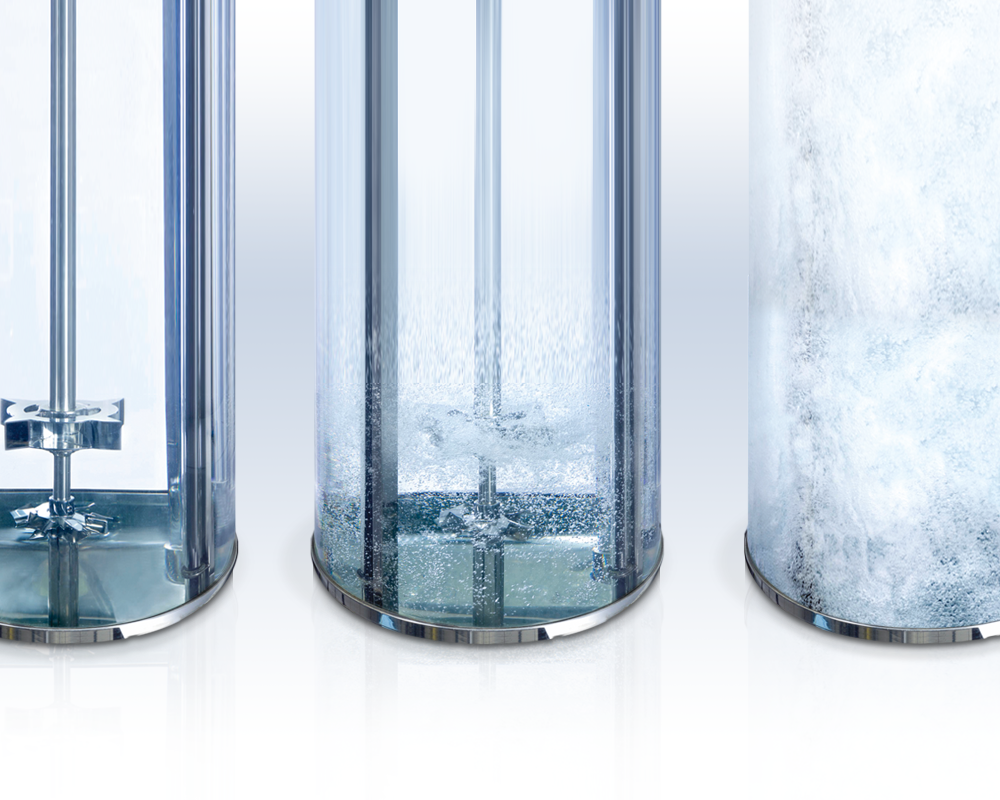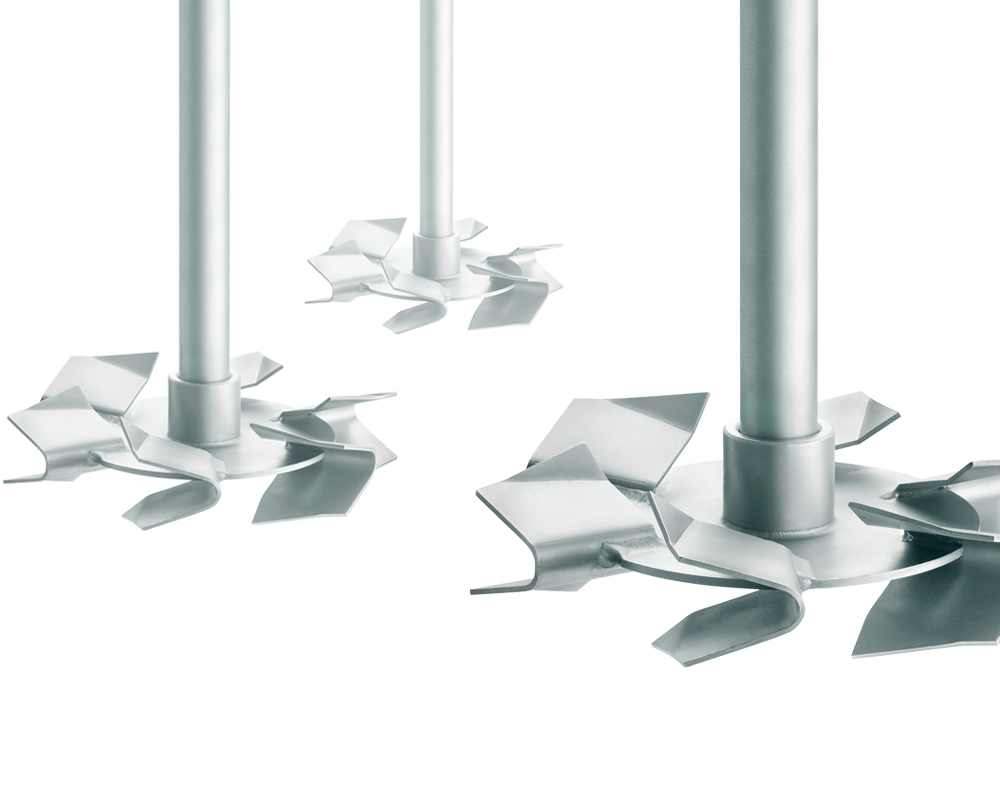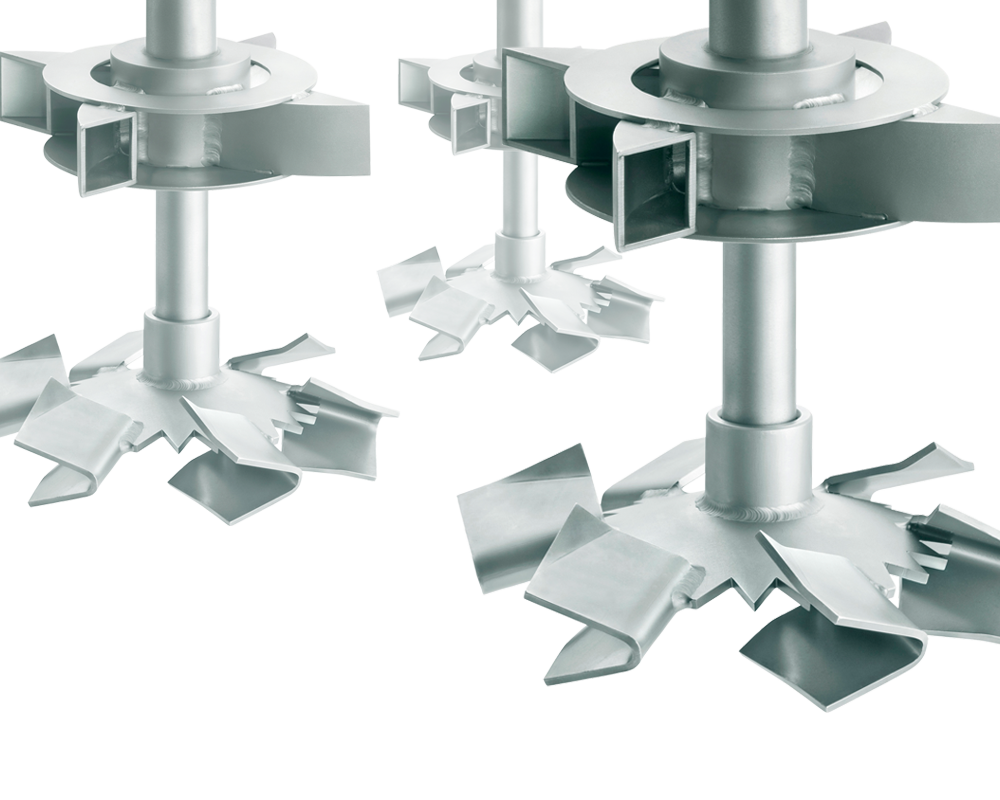
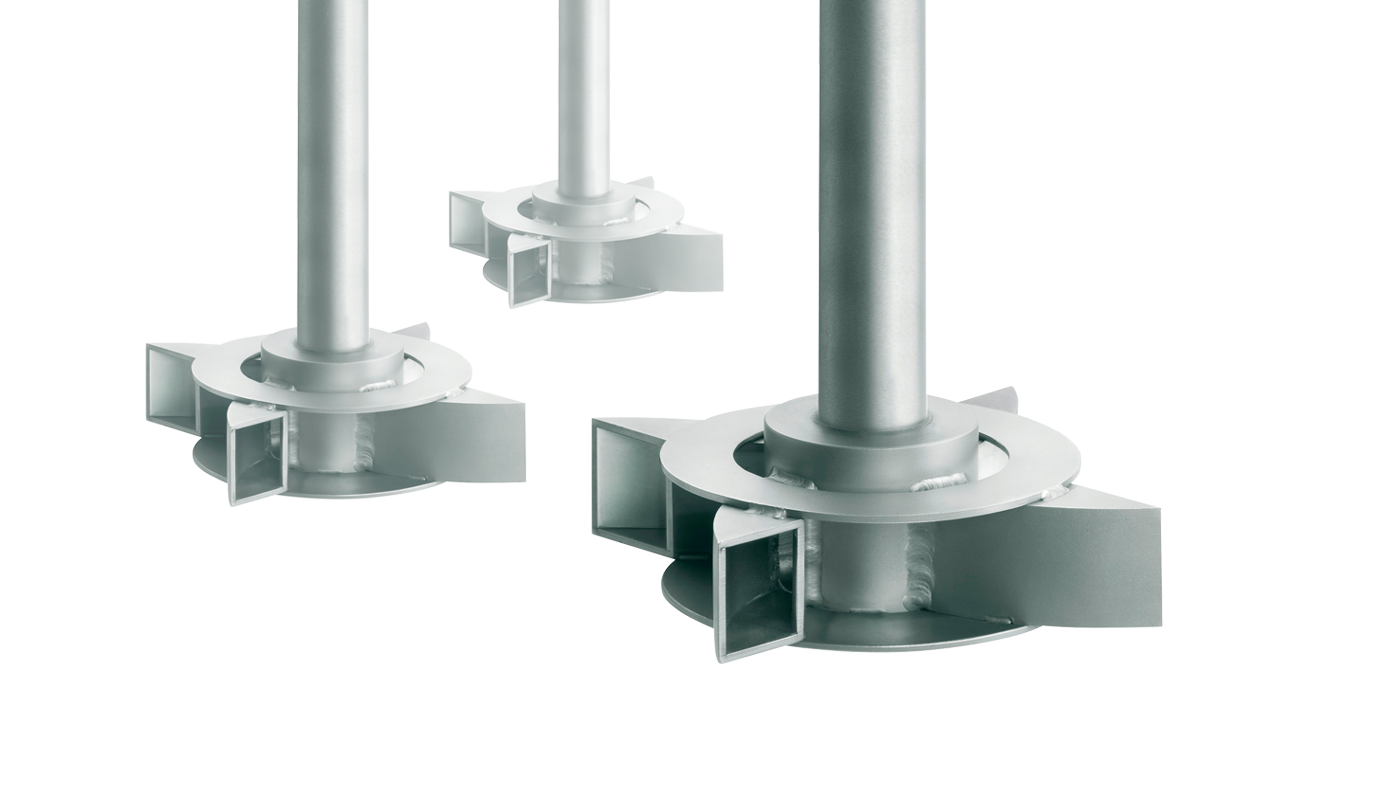
The GASJET is a self-aspirating gassing impeller for internal recirculation of the gas from the reactor head back into the liquid. It ensures complete conversion of technically pure gases.
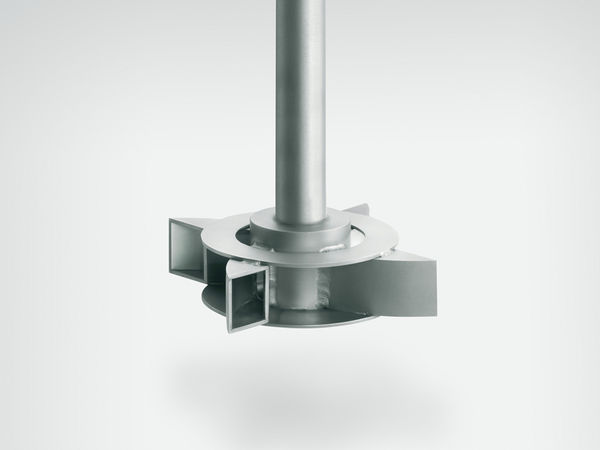
The EKATO GASJET is a self-aspirating impeller. Gas is aspirated through the hollow shaft of the GASJET and then passes through specially shaped gas ducts at the end of the shaft.
The vacuum pressure generated by impeller rotation on the outer openings sucks the gas out into the liquid where it is finely distributed. There are also chambers between the gas ducts whose cover discs have openings facing the hub.
The pure liquid in the vessel is sucked in through these openings and then guided to the gas outlets where the gas is being dispersed. The separate flow of gas being dispersed by the EKATO GASJET and its intensive liquid pumping efficiency results in a higher mass transfer owing to the additional contact surface area created between the moving liquid and the aspirated gas.
Conventional self-aspirating turbines with covered gas ducts have a limited gas throughput because they are susceptible to self-flooding. This problem is prevented by the design of the EKATO GASJET, thus enabling it to cope with higher gas feed rates than conventional designs. The combination of EKATO GASJET and EKATO PHASEJET maximizes space/time yields in reactions with pure gases like in hydrogenation processes.

EKATO GASJET
You are currently viewing a placeholder content from YouTube. To access the actual content, click the button below. Please note that doing so will share data with third-party providers.
EKATO GASJET Impeller for gas-liquid applications with pure gases

Impellers Contact Form
Related Topics
You may also be interested in these topics
Mixing Tasks
Precise knowledge or analysis of the required basic mixing tasks are always the first step towards the optimum mixing technology solution. Based on th…
Top-entry and side-entry agitators (e.g., EM 2000, ES 2000, MD/SD)
Solutions for storage tanks, open and closed vessels
Simple mechanical seals
Short delivery times, high cost-efficiency
On-site commissioning and service
What does “Number of sealing faces” mean?
Single-acting mechanical seals These seals have one sealing surface and only seal in one direction. They are generally simpler in design and are commonly used in applications where pressure is applied from only one side.
Double-acting mechanical seals These seals have two sealing surfaces and can seal in both directions. They are ideal for applications where pressure may come from both sides or where a higher sealing performance is required.
Triple-acting mechanical seals These are less common and used in specialized applications that require a more complex sealing setup. They offer additional sealing surfaces or mechanisms to ensure reliable sealing even in highly demanding environments.
You are currently viewing a placeholder content from Google Maps. To access the actual content, click the button below. Please note that doing so will share data with third-party providers.
You are currently viewing a placeholder content from Facebook. To access the actual content, click the button below. Please note that doing so will share data with third-party providers.
You are currently viewing a placeholder content from hCaptcha. To access the actual content, click the button below. Please note that doing so will share data with third-party providers.
You are currently viewing a placeholder content from Turnstile. To access the actual content, click the button below. Please note that doing so will share data with third-party providers.